
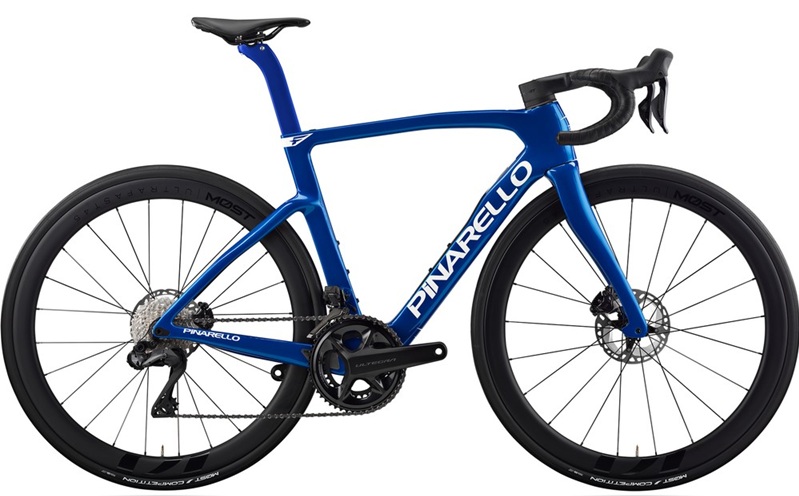
Tested on the road: Pinarello F7 Shimano Ultegra Di2 2026. Find out if it's really worth €8,000 or just a compromise on M90 carbon. Real weight and verdict.
⚡ THE 3-LINE SUMMARY (For those in a hurry)
The substance without the crazy price tag: The F7 inherits the aerodynamics and geometry of the renowned Dogma F, but uses Toray M90 carbon to slash manufacturing costs, bringing the list price to around €8,000 with an Ultegra Di2 groupset.
The scale's verdict: It weighs roughly 7.8 kg in a standard size (without pedals): not a featherweight climber for alpine walls, but an aerodynamic steamroller.
The hidden major advantage: On the road, it is more comfortable and less fatiguing over long distances compared to the Dogma F itself, with downhill stability that has very few rivals worldwide.
There is a subtle, almost magnetic charm when you lay eyes on a bicycle rolling out of the Treviso workshops. The Pinarello brand doesn't just sell two-wheeled machines; it commercializes a piece of cycling history and a global status symbol. But while the Dogma F represents an unattainable object of desire for most bank accounts, the Pinarello F7 with Shimano Ultegra Di2 2026 steps up as the smart choice for the advanced racer and demanding enthusiast.
However, compromising on the price tag (sitting between €7,900 and €8,200) means figuring out whether you're truly taking home the essence of victory with zero regrets, or if this is just a well-packaged marketing play. We analyzed it point by point, cutting through common clichés and looking at the real numbers.
1. M90 Carbon and Finishes: Where Is the Cost Cut?
At first glance, parked next to its bigger sister the Dogma F, the F7 holds its head high. The differences in surface finishes and attention to detail are virtually invisible to the untrained eye.
The secret behind squaring the circle lies in frame layup: Pinarello chose to use Toray M90 carbon fiber instead of the nobler, costlier T1100 found on the Dogma. This precise technical choice contains industrial costs without compromising the torsional stiffness of the bottom bracket when you stand up and sprint full gas. On top of this, thanks to the iconic round "P" badge, resale value historically remains among the highest in the cycling market.
2. Geometry and the Weight Factor: What Does the Scale Say?
Tube shapes scream aerodynamics from every centimeter, directly borrowing wind tunnel testing from the World Tour. A historic plus for Pinarello remains its massive range of catalog sizes: finding the perfect biometric fit without resorting to custom frames is a breeze here.
However, there is one hard metric you must deal with. In standard configuration with the Shimano Ultegra Di2 group and carbon wheels, the scale stops at roughly 7.8 kg (without pedals). We aren't looking at a featherweight Gran Fondo climbing special: that extra kilo compared to sub-7 kg extreme builds makes itself felt when the road kicks up past 10%.
3. Shimano Ultegra Di2: Mechanical Certainty
In terms of transmission, the Shimano Ultegra Di2 12-speed semi-wireless groupset represents arguably the best quality-to-price compromise on today's market. Shifting is surgical, lightning-fast, and free of hesitation even under maximal load, while the hydraulic braking system offers modulation and stopping power that instill total control when the asphalt turns slick or dusty.
4. The Real Plot Twist: Comfort Beats the Dogma F
If you expected a rigid, punishing wooden board due to its racing DNA, you will be surprised. Paradoxically, one of the F7's greatest strengths over the Dogma F is its ride comfort.
The slightly less extreme elastic response of the M90 fiber acts as a natural filter against micro-vibrations from rough asphalt and long distances. Your back and shoulders will thank you after five hours in the saddle: the F7 wasn't built as a plush endurance bike for cycle-touring, but it treats the rider with far more leniency than pure World Tour frames.
5. Road Behavior: Benchmark Handling
When the road drops or flattens out, the Pinarello F7 bares its claws and justifies its prestigious lineage:
Stability and Descents: This is where the bike turns into a bullet train. Stability at ultra-high speeds is disarming; dropping the bike into an alpine hairpin requires just a single thought, and the line is carved with surgical precision. For anyone who struggles with downhill nerves, the F7 is a massive injection of confidence.
Climbing: As mentioned, those 7.8 kg make their presence felt. On steep punches and sudden changes of pace, the bike demands solid power and a round pedal stroke to maintain momentum, rewarding powerful power-climbers rather than pure lightweight mountain goats.
Flats and Rolling Terrain: On long stretches and aero false flats, the F7 flies, leveraging profile inertia and front-end stiffness to maintain high cruising speeds with reduced energy expenditure.
6. Pros and Cons Without Fluff
🏆 The Real Advantages
Top-tier handling and descents: Stability and high-speed security that competitors struggle to match.
Comfort superior to the Dogma F: Less stressful and fatiguing over long distances thanks to the filtered frame response.
Geometric fit range: An exceptional size catalog allowing anyone to find their perfect fit.
Residual value: A blue-chip asset on the used market thanks to the Treviso brand.
⚠️️ The Drawbacks (What They Don't Tell You)
Weight isn't record-breaking: The 7.8 kg inevitably pays a toll on the steepest alpine climbs and standing restarts.
Major financial outlay: Though cheaper than the Dogma, it remains an investment exceeding €8,000.
7. Frequently Asked Questions (FAQ)
What is the actual weight of the Pinarello F7 with Ultegra Di2?
In a standard size and without pedals, the scale registers an actual weight of roughly 7.8 kg.
What is the main handling difference compared to the Dogma F?
The F7 uses Toray M90 fiber instead of T1100: it is slightly heavier, but offers superior long-distance comfort and is less "twitchy" to ride.
Is the frame compatible with traditional mechanical drivetrains?
No, the geometry and cable routing of the F series are natively designed exclusively for integrated electronic groupsets (like Shimano Di2).