
Best Gravel Tires Winter 2025-2026: Compounds, Pressures, and Technical Advantages
Best Gravel Tires Winter 2025-2026: Compounds, Pressures, and Technical Advantages
Gravel riding during the cold season requires a fundamental configuration change. Summer semi-slick tread patterns are abandoned to prioritize the aggressiveness of the tread, which is essential for ensuring stability and traction on mud, wet gravel, and slick terrain.
Technical Analysis: The Essence of the Winter Gravel Tire
The main goal of the winter Gravel tire is adhesion (grip), achieved through the interaction between the knob morphology and the tread compound.
Aggressive Tread Pattern (Tassellatura): Unlike all-round summer models, winter tires require taller and more widely spaced knobs. This spacing is vital for self-cleaning, allowing mud to quickly shed and the tire to maintain contact with the ground. The knobs on the shoulders must be robust and pronounced to maximize cornering grip on yielding surfaces.
Specific Compound (Mescola): Compounds are designed to maintain elasticity at low temperatures. Tires with Dual-Compound technologies or specific soft compounds (similar to Enduro MTB ones) offer increased adhesion on wet roots and rocks, despite a slight increase in rolling resistance.
Wide Section (Sizes): Tire width is crucial. The use of sections from 40 mm to 50 mm (on both 700C and 650B wheels) is widely recommended in winter. The wider section increases the air volume and the contact patch, allowing for the use of lower pressures, improving comfort and floatation on mud.
Top-Tier Models for Mud and Wet Conditions (2025-2026)
To tackle the most challenging conditions, Gravel riders rely on tires with tread patterns derived from the MTB world:
Schwalbe G-One Bite: Recognized for its open tread pattern and reinforced outer blocks, it offers exceptional cornering stability and excellent off-road versatility. It is often the benchmark for those seeking greater grip compared to the G-One Allround.
Continental Terra Trail: This model is specifically geared towards maximizing adhesion on moderately uneven terrain and gravel. It is designed with BlackChili technology borrowed from MTB, ensuring good performance in the wet and robust protection.
Hutchinson Tundra: Designed with the most extreme conditions and mud in mind, it is ideal for the more technical and wet trails, guaranteeing effective traction grip.
Maxxis Ravager: This tire is positioned as the most aggressive tire in the Maxxis gravel range, particularly suitable for loose and wet terrain, offering stability and control even in unpredictable conditions.
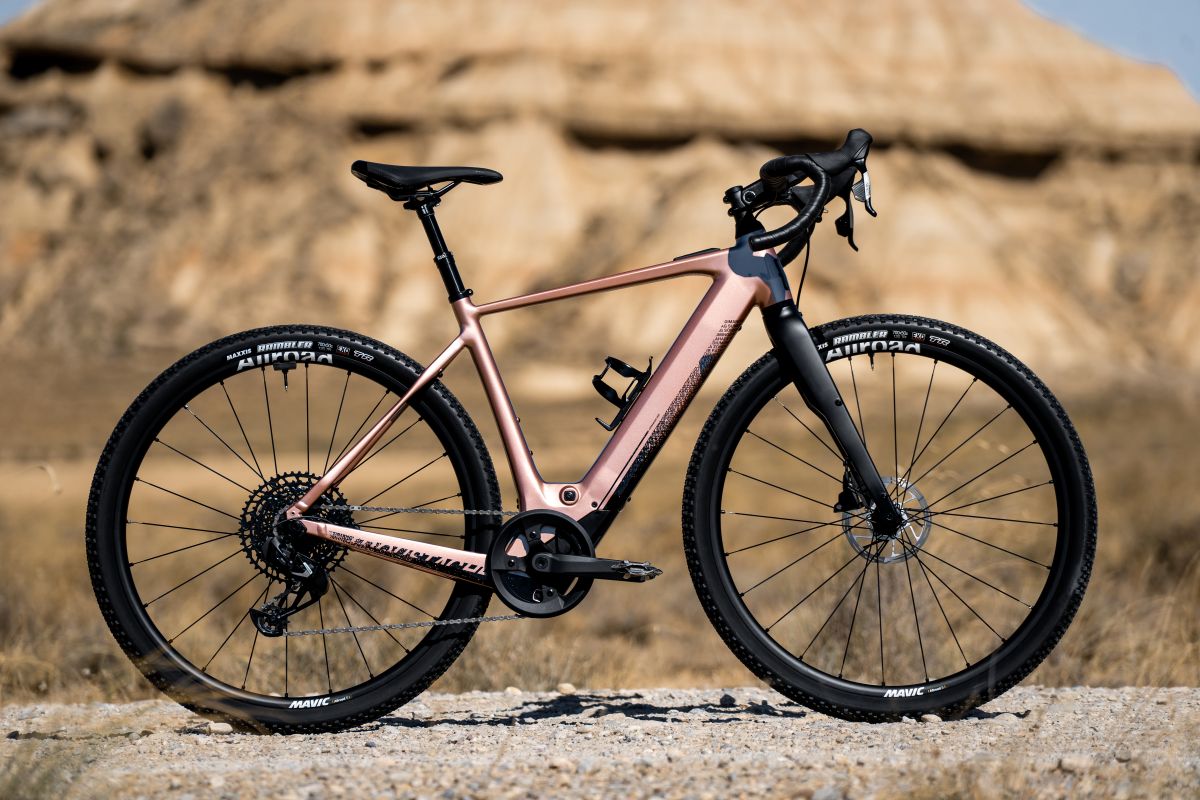
A Mixed Setup (Differentiated) is often recommended: Use a more aggressive tire (e.g., Ravager or G-One Bite) on the front for safety in corners and braking, and a slightly faster-rolling model (like Maxxis Rambler or Vittoria Terreno Mix) on the rear to balance traction and speed.
Inflation Pressures and Tubeless Technology
On mud and wet ground, the pressure must be reduced compared to standard summer values to increase the contact patch and maximize grip, preventing slippage.
General Rule for Mud:
Reduction: It is recommended to start with a pressure 0.2–0.5 Bar (approx. 3−7 PSI) lower than the ideal pressure for dry conditions.
Distribution: The pressure of the front tire should be approximately 0.2–0.3 Bar lower than the rear, as the latter supports about 60% of the total weight.
Reference Pressure (70−85 kg, 40−45 mm Tubeless): Typical values range between 2.5 and 3.5 Bar (36−50 PSI), but in the case of mud, one can drop towards the lower limit of this range to achieve greater adhesion.
The Advantage of Tubeless and Inserts:
The use of the Tubeless system is almost mandatory in winter Gravel, as it allows safe operation at the lower pressures required by muddy terrain, eliminating the risk of inner tube pinch flats.
Furthermore, the eventual integration of tire inserts (like the Air-Liner Light Gravel) inside the tire allows for further pressure reduction (approx. 0.3−0.5 Bar less) without compromising lateral stability and ensuring rim protection in case of heavy impact.
The choice for winter is, therefore, oriented towards safety and control, transforming one's bike from a fast machine into a vehicle capable of tackling any kind of adverse condition.