
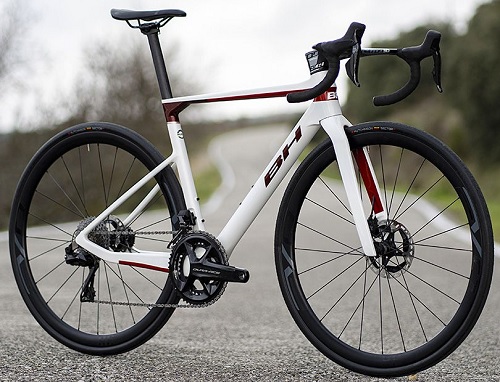
The BH Ultralight Evo 2026 reinforces its reputation as the ultimate road racing bike for climbers and pure elevation enthusiasts from the Spanish brand. Redesigned to combine its legendary featherweight characteristics with aerodynamic profiling derived from its aero sibling, the G8 Disc, the Ultralight Evo strikes an ideal balance between immediate acceleration, torsional stiffness, and sleek cable integration. Crafted using advanced Hollow Core Internal Molding (HCIM) technology and Toray T1100G carbon fiber, this bike is built to conquer the steepest gradients without compromising stability during high-speed sprints or technical descents.
CyclOnline Rating: 9.1 / 10
Verdict: A pure climbing machine that holds its own on flat sections thanks to smart aerodynamic optimization. It delivers lightning-fast acceleration and direct road feedback, though it requires a trained core and back on rough road surfaces.
Recommended Spec: BH Ultralight Evo 9.0 (the ideal build featuring a 12-speed Shimano Ultegra Di2 electronic groupset, Vision Metron 45 SL carbon wheels, and an integrated carbon cockpit).
In Short: Key Takeaways
Category: Road Race / Climbing / Light Aero.
Frame Technology: Toray T1100G carbon fiber and Pitch Fiber combined with the high-pressure HCIM (Hollow Core Internal Molding) process. Unpainted frame weight is approximately 750 g in Size M.
Cable System & Integration: Fully integrated ACR (Aerodynamic Cable Routing) through the headset and one-piece monocoque carbon cockpit.
Geometry: Sharp 73° head tube angle, ultra-short 410 mm chainstays, compact reach, and an aggressive stack height for an uncompromised race position.
Pros: Lightning-fast responsiveness on steep climbs, top-tier stiffness-to-weight ratio, pristine integrated aesthetics, and locked-in handling on descents.
Cons: Harsh vertical compliance on degraded road surfaces, complex headset area maintenance due to internal routing, high-end price bracket.
Frame Technical Analysis: Toray T1100G Fiber & HCIM Construction
The chassis of the BH Ultralight Evo 2026 is engineered to eliminate unnecessary material and dead weight.
HCIM Molding Process: Hollow Core Internal Molding applies high internal pressure inside the mold during carbon curing, preventing imperfections, air pockets, or resin pooling inside the tubes.
Toray T1100G Carbon Layup: Utilizing high-modulus, ultra-high-tensile fibers allows for thinner tube walls while boosting torsional stiffness at the BB386 EVO bottom bracket shell.
Kammtail Profiles & Rear Stays: Unlike older generations, the tube shapes feature truncated "Kammtail" airfoils to reduce aerodynamic drag. The seatstays join low on the seat tube for controlled vertical compliance, while the chainstays measure a short 410 mm for maximum power transfer.
Race Geometry & Ride Dynamics
The geometry reflects the Basque manufacturer's pure racing lineage, tailored for riders seeking an aggressive, low-profile position.
BB386 EVO Bottom Bracket Shell: The wide 86.5 mm shell allows for an oversized junction between the down tube and seat tube, eliminating lateral flex during out-of-saddle efforts.
Head Angle & Wheelbase: A 73° head angle paired with a tight wheelbase ensures immediate steering response when initiating turns and making quick line adjustments.
Tire Clearance: Despite its pure climbing focus, the frame comfortably clears tires up to 30 mm (measured width), essential for balancing grip and vibration dampening.
Field Performance: Climbing, Flat Terrain, and Descending
1. Climbing Performance (Gradient & Steeps)
This is where the BH Ultralight Evo thrives:
Gradients Over 8–10%: The bike feels weightless beneath the rider. Every out-of-saddle pedal stroke results in immediate forward acceleration with zero flex.
Gradual & Tempo Climbs: The light chassis and rigid integrated cockpit allow riders to hold high cadences and change pace effortlessly.
2. Flat Terrain, Sprints, & Acceleration
While not a dedicated aero frame like the BH Aerolight, the Ultralight Evo performs surprisingly well on flat terrain:
Speed Maintenance: Reduced frontal profile area and hidden cables keep the bike from feeling sluggish above 40 km/h (25 mph).
Out-of-Corner Sprints: The combination of mid-depth carbon wheels and a stiff frame delivers instantaneous response when accelerating out of tight corners.
3. Descending Performance (Technical & High-Speed)
On descents, the bike demands confident rider input while offering exceptional feedback:
Front-End Precision: The full-carbon tapered fork offers surgical precision through high-speed apexes.
Smooth Asphalt Stability: Tracks lines predictably, allowing late braking thanks to hydraulic disc power.
Rough Surface Feedback: On cracked or uneven pavement, the rigid frame transmits vibrations directly. A firm grip and optimized tire pressure (4.5–5.0 bar recommended for 28 mm tubeless setups) are essential.
Component Analysis (Ultralight Evo 9.0 Build)
Shimano Ultegra Di2 12-Speed Groupset (R8100): Rapid, quiet, and precise gear shifts with reliable semi-wireless execution.
Vision Metron 45 SL Carbon Disc Wheels: A 45 mm deep carbon rim paired with smooth-rolling bearings, providing a sweet spot between climbing weight and aero efficiency.
BH Evo Monocoque Carbon Integrated Cockpit: One-piece handlebar and stem design that hides brake hoses and Di2 wires completely while keeping weight down.
Shimano Ultegra Hydraulic Brakes (160 mm Front / 140 mm Rear Rotors): Well-modulated stopping power with zero fade on long alpine descents.
Seatpost & Prologo Dimension Saddle: Dedicated carbon seatpost with a hidden integrated wedge clamp, paired with a short-nose saddle for aggressive efforts.
Pros and Cons
Pros
Unmatched Responsiveness: Instant pedal response, ideal for attacking steep gradients.
Sleek Integration: Clean, cable-free cockpit aesthetic using the ACR system.
Category-Leading Weight: Complete builds sit comfortably under 7.2 kg without pedals.
Bottom Bracket Stiffness: Pure power transfer with zero frame flex.
Cons
High Vertical Rigidity: Firm rear end can cause fatigue on rides exceeding 4 hours over uneven asphalt.
Cockpit Maintenance: Replacing headset bearings or adjusting stack height requires extra time and mechanical expertise.
Crosswind Sensitivity: Paired with 45 mm+ deep rims, the light frame requires a steady hand in strong gusty crosswinds.
Detailed Technical Specifications
Frame: BH Ultralight Evo Carbon Monocoque (Toray T1100G), HCIM Technology, BB386 EVO, Flat Mount Disc, 12x142 mm Thru-Axle
Fork: BH Ultralight Evo Integrated Carbon Full Carbon, 1.5", Flat Mount Disc, 12x100 mm Thru-Axle
Drivetrain: Shimano Ultegra Di2 R8150 12-speed
Crankset: Shimano Ultegra 52/36T (or 50/34T option)
Cassette: Shimano Ultegra CS-R8100 11-30T or 11-34T 12-speed
Brakes: Shimano Ultegra Hydraulic Disc, Shimano RT-MT800 Rotors (160 mm Front / 140 mm Rear)
Wheelset: Vision Metron 45 SL Carbon Disc, Tubeless Ready
Tires: Hutchinson Fusion 5 Performance 700x28c
Integrated Cockpit: BH Evo Monocoque Carbon ACR
Seatpost: BH Ultralight Carbon
Saddle: Prologo Dimension Tirox
Measured Weight: 7.15 kg / 15.76 lbs (Size M, Tubeless setup, without pedals)
MSRP (Approx.): € 6,999 / $ 7,200
Market Comparisons & Alternatives
VS Specialized S-Works Tarmac SL8: The Tarmac SL8 leans further into aerodynamic shaping to optimize weight-to-drag ratios. However, the BH Ultralight Evo offers comparable stiffness and a pure climber's ride feel at a more accessible price point.
VS Cannondale SuperSix EVO: The SuperSix EVO offers slightly more vertical compliance over rough surfaces, whereas the BH Ultralight Evo reacts with more immediate snap during out-of-saddle efforts.
VS Wilier Triestina Verticale SLR: Both bikes target hill-climb performance. The Wilier boasts an ultralight frame, but the BH responds with an oversized bottom bracket junction that delivers higher stiffness under high-wattage sprints.
Who Should Buy the BH Ultralight Evo 2026?
The BH Ultralight Evo is an ideal choice for:
Climbers and Competitive Gran Fondo Riders: Cyclists targeting high elevation gain who want every weight and power advantage on steep ascents.
Riders Who Prefer Direct Power Transfer: Anyone who loves the feel of a rigid frame that snaps forward the instant you stomp on the pedals.
Aesthetic Enthusiasts: Riders seeking a clean race bike with hidden hoses and sleek lines.
It is not recommended for endurance riders seeking an upright, relaxed geometry, cyclists who frequently ride heavily degraded roads or cobblestones, or those who prefer traditional, easy-to-service exposed cabling setups.
FAQ - Frequently Asked Questions
What is the maximum rider weight capacity for this frame?
BH rates its high-modulus carbon frames for a total system load (rider plus gear) of up to approximately 110 kg (242 lbs).
Can I run a mechanical groupset on this frame?
No. The latest BH Ultralight Evo platform is engineered exclusively for electronic drivetrains (Shimano Di2 or SRAM AXS) to maintain its fully internal ACR hose routing.
Can I fit 30 mm tires?
Yes. Frame and fork clearances accommodate measured tire widths up to 30 mm with ample room to spare.
Can you adjust handlebar height on the integrated cockpit?
Yes. The system uses split aerodynamic spacers, allowing you to adjust stack height without disconnecting the hydraulic brake lines.